read
reference: Dieter F. Kutz et al. 2022. Finger Tapping as a Biomarker to Classify Cognitive Status in 80+-Year-Olds
Introduction
- It is therefore important to identify people with pre-dementia (e.g., persons with mild cognitive impairments, or MCI) early enough so they can start programs that will help them maintain their personal lifestyle and that will continuously assess the course of the dementia as it progresses.
- In many therapeutic areas, diseases and treatments are evaluated using patient- reported outcome (PRO) measures (subjective measures), collected, for example, via questionnaires
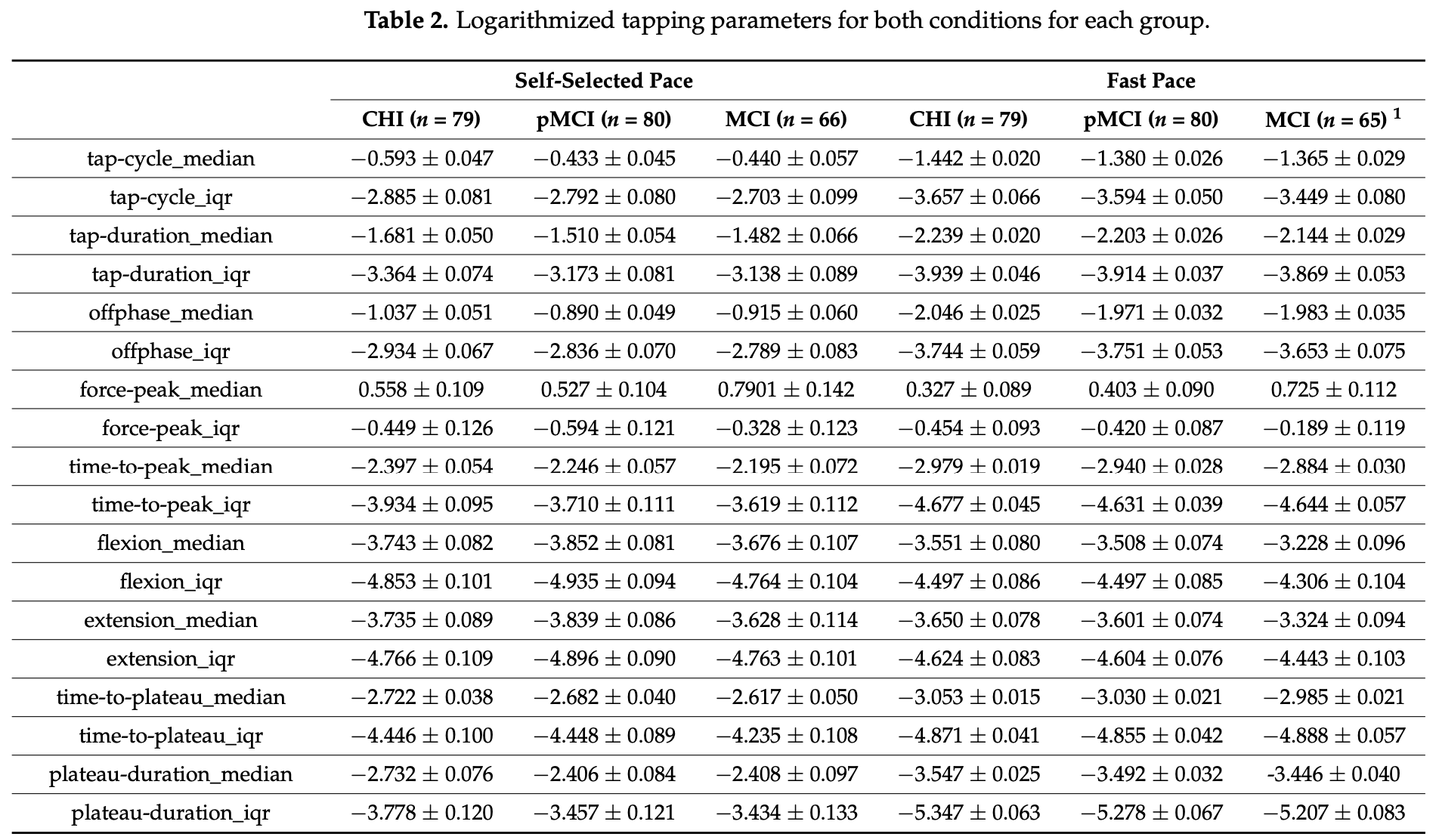
Frank, L.; Lenderking, W.R.; Howard, K.; Cantillon, M. Patient self-report for evaluating mild cogitive impairment and prodromal Alzheimer’s disease. Alzheimers Res. Ther. 2011, 3, 12. - In this study we aimed to use tapping parameters to distinguish between participants over 80 years old who were either cognitively healthy individuals (CHI), mild cognitive impaired individuals (MCI) or had possible MCI (pMCI), in two different conditions: as consistently as possible at a self-selected pace or as fast as possible without considering consistency (fast pace).
Materials and Methods
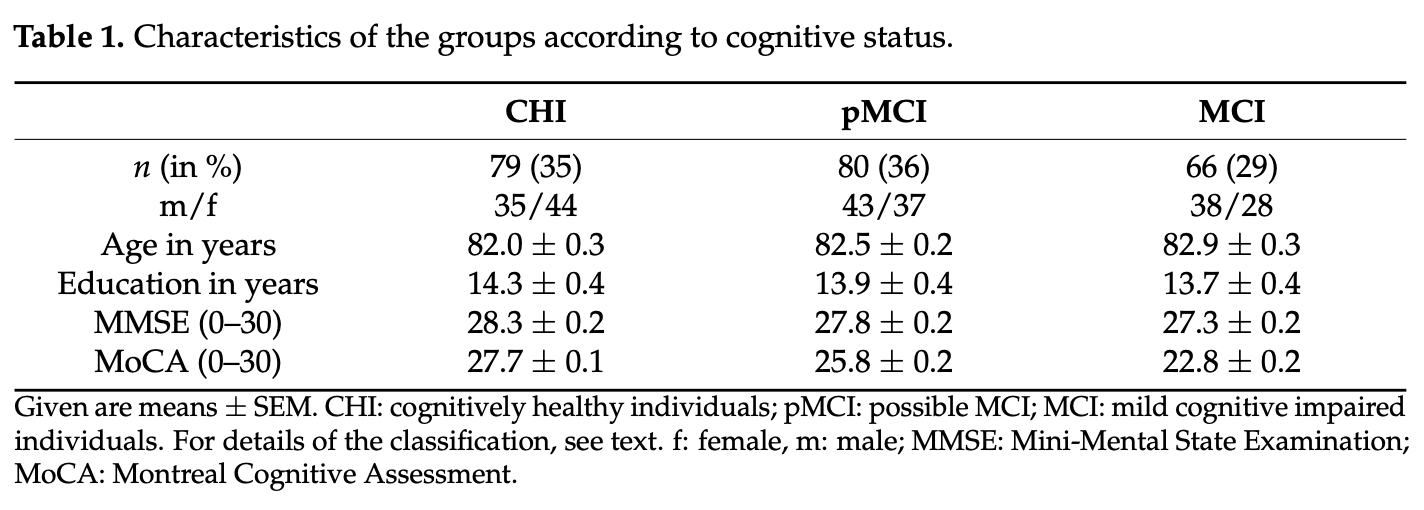
- The MoCA is the second-most-utilized geriatric cognitive screening tool after the Mini-Mental State Examination (MMSE) and has superior sensitivity to mild cognitive impairments.
Breton, A.; Casey, D.; Arnaoutoglou, N.A. Cognitive tests for the detection of mild cognitive impairment (MCI), the prodromal stage of dementia: Meta-analysis of diagnostic accuracy studies. Int. J. Geriatr. Psychiatry 2019, 34, 233–242. - MCI classification was based on the recommendations of The National Institute on Aging and the Alzheimer’s Association
Albert, M.S.; DeKosky, S.T.; Dickson, D.; Dubois, B.; Feldman, H.H.; Fox, N.C.; Gamst, A.; Holtzman, D.M.; Jagust, W.J.; Petersen, R.C.; et al. The diagnosis of mild cognitive impairment due to Alzheimer’s disease: Recommendations from the National Institute on Aging-Alzheimer’s Association workgroups on diagnostic guidelines for Alzheimer’s disease. Alzheimers Dement. 2011, 7, 270–279.
Result
- In the self-selected pace condition, the groups did not behave differently: CHI performed 86.5 ± 4.1 taps on average (mean ± standard error of the mean (SEM)), pMCI 74.3 ± 3.4 taps, and MCI 74.9 ± 4.6 taps. In contrast, in the fast pace condition, MCI produced 114 ± 4.2 taps, significantly less than CHI (127 ± 3.2 taps, paired t-test with Bonferroni’s correction, p = 0.019). pMCI (119 ± 2.9 taps) was not different compared with the other two groups.
Discussion
- When the algorithm was used to classify individual participants, it was correct in only 50% of cases. This shows that tapping parameters were only partially useful for classification.
- However, the planned goal of classifying individual participants based on tapping parameters was only partially achieved. Thus, while 49 of 79 CHI participants were correctly classified on the basis of their motor performance, 30 of these participants were classified as pMCI or MCI.